REVIEW · ATHENS
Athens: The Acropolis Museum Guided Tour
Book on GetYourGuide →Operated by ATHENS WALKING TOURS · Bookable on GetYourGuide
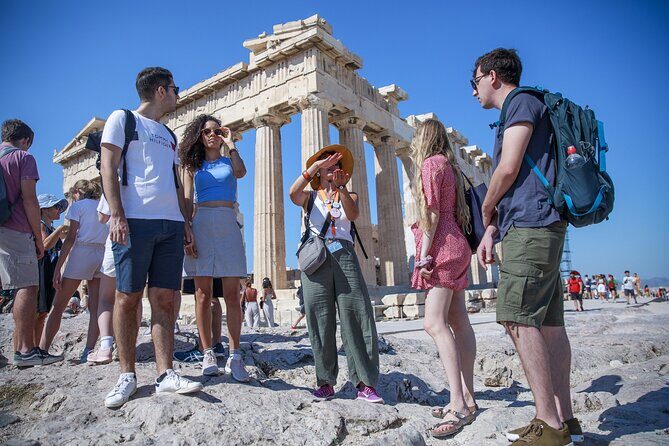
A museum tour that makes the Parthenon click. In 75 minutes, you get a focused, guided route through the Acropolis Museum that explains what you’re actually looking at before you face the stones above. I love the way the guide turns artifacts into a story about Athens in the 5th century BC, and I also love the museum’s design tricks that connect the collection to the ruins outside.
My second favorite part is how quickly you get context you’d miss on your own. The tour points you toward major highlights like votive offerings to Athena and the Caryatids, plus it shows how excavations are literally revealed through glass floors. With a live English guide, you can follow the big picture without getting lost in dates and names.
The main drawback to plan around is time. The museum portion is only about an hour and a quarter, so you’ll want to arrive ready and accept that you may not see every corner of the museum at a relaxed pace—especially if your tour slot is linked to an earlier Acropolis stop.
In This Review
- Key things worth knowing before you go
- Why the Acropolis Museum makes your Acropolis visit make sense
- Bernard Tschumi and Michael Photiadis: architecture that you can use
- Getting to the meeting point on Dionysiou Areopagitou (and why it matters)
- A 75-minute route: what the guide actually walks you through
- The 1st-floor Archaic Gallery: natural light plus real meaning
- Votive offerings to Athena and the Caryatids: more than decoration
- The glass atrium aligned with the Parthenon: a smart visual connection
- Excavations through glass floors: seeing the ground truth
- 3D exhibits and a look at an ancient Athenian neighborhood
- Panoramic views of the Acropolis ruins, from inside
- Price and value: what $41 plus entrance fees really means
- What can slow you down: short duration and starting points
- Practical tips that make your guided visit smoother
- Who should book this Acropolis Museum guided tour?
- Should you book this Acropolis Museum guided tour?
- FAQ
- How long is the Athens Acropolis Museum guided tour?
- What is included in the price?
- Are entrance fees included?
- Where do I meet the tour staff?
- Is the tour guide available in English?
- Is the tour wheelchair accessible?
- Is luggage allowed?
- What should I bring?
- Does the tour run in bad weather?
- What are the cancellation and payment options?
Key things worth knowing before you go

- Museum-first logic: You learn the meaning of key objects before you see the Acropolis itself.
- Natural light + glass floors: 1st-floor galleries and visible excavations help you understand what sat here long ago.
- Athena offerings and Caryatids: These are explained as more than decoration.
- Parthenon-aligned architecture: The glass atrium is designed to line up with the Parthenon view.
- Panoramic ruins views: You get a “museum to monument” connection while staying indoors.
- Guides bring the stories: Many guides on this experience use humor and clear explanations (including Dimitris, Margherita, Niobe, Annie, Natasha, Jordan, Apollo, Kimon, and Chris from past departures).
Why the Acropolis Museum makes your Acropolis visit make sense
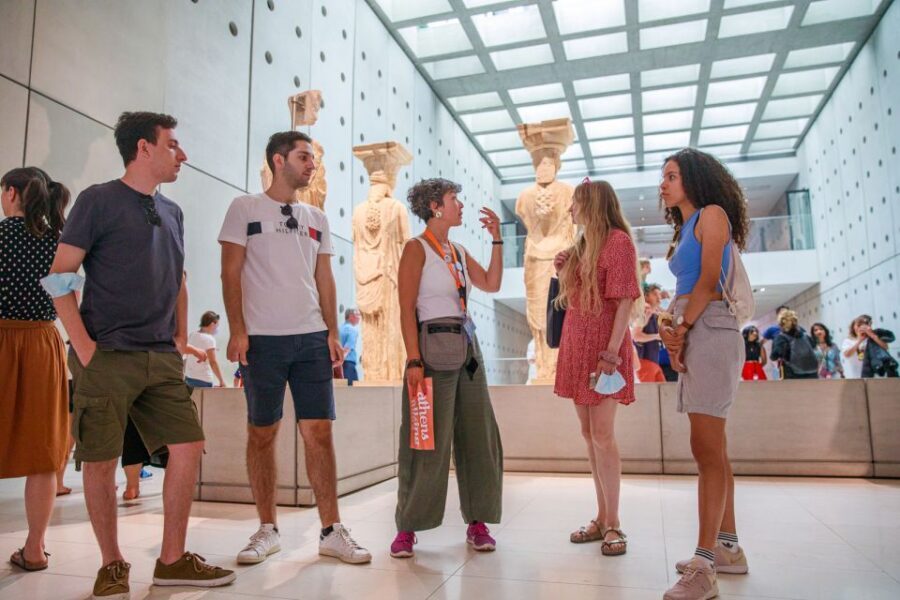
I think the best way to understand the Acropolis is to visit the museum first. The collection helps you see the sculptures, offerings, and design choices as part of a living religious and civic world—not just pretty ruins. When you later look up at the hill, the artifacts’ themes (gods, ceremonies, power, artistry) snap into place.
This guided format is built for time-squeezed visitors. At 75 minutes, you’re not wandering aimlessly; you’re led toward the museum’s most meaningful stops, with someone answering the questions that usually pop up mid-visit. That’s especially helpful if you’re not trying to become a full-time archaeologist before lunch.
Other Acropolis and Parthenon tours we've reviewed in Athens


Bernard Tschumi and Michael Photiadis: architecture that you can use

One reason this museum feels different is that the building itself does work for you. The modernist design by Bernard Tschumi and Michael Photiadis isn’t just a backdrop; it’s part of the storytelling. You’ll notice how the museum opens up to views and sightlines that connect indoors exhibits with the outdoor landmark everyone came for.
The tour also highlights the museum’s glass atrium built in alignment with the Parthenon. In plain terms, you’re shown how the design helps you understand the relationship between what was created and where it was meant to be seen. If you like architecture that actually has a purpose, this is the kind that rewards your attention.
Getting to the meeting point on Dionysiou Areopagitou (and why it matters)

Meeting point is 3, Dionysiou Areopagitou St. at the Lukumades & Pilino stores. The staff—holding an orange Athens Walking Tours sign—are waiting for you at that spot at the beginning of the pedestrian walkway heading from Hadrian’s Arch area (Syngrou Avenue direction, also written as Siggrou) toward the Acropolis.
This matters because this tour is short. If you show up late, you don’t just risk missing a few minutes—you can end up with less time for the highlights. I’d treat the meeting time as serious business, wear comfortable shoes, and plan a little buffer while you navigate the pedestrian approach.
A 75-minute route: what the guide actually walks you through
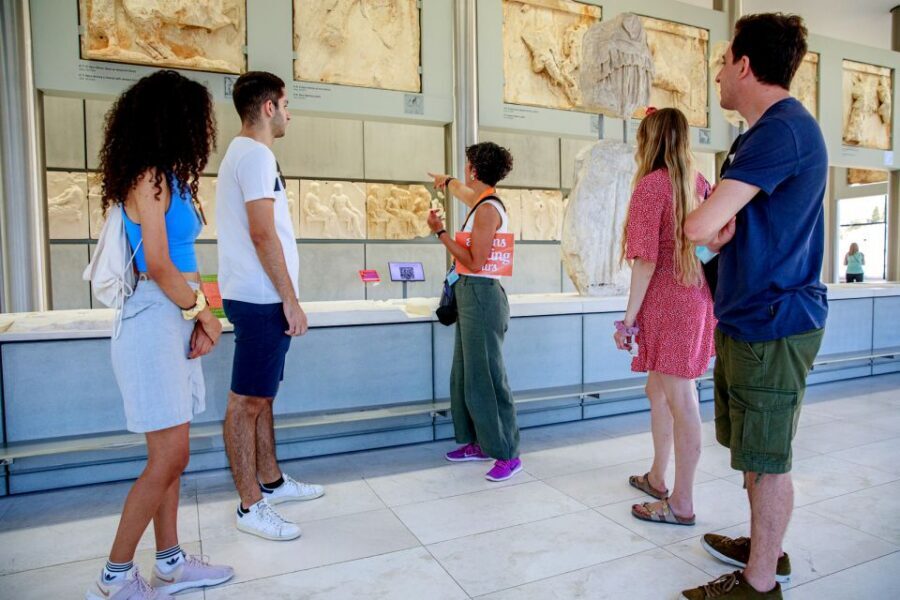
The museum tour is designed as a tight “highlights with context” route. You’ll focus on the museum’s most important galleries and features, not every display. That’s ideal if you want the key points fast, but it’s also why you should go in with clear expectations: this is about understanding, not covering everything.
Here’s what you can expect the guide to structure for you:
- You start with a big-picture orientation to the collection and what the museum preserves.
- You move through the Archaic Gallery on the 1st floor, which is bathed in natural light.
- You spend time on signature exhibits and explanatory displays, including sections tied to Athena and the Caryatids.
- You finish with the museum’s “time-travel” elements, including the excavation views through glass and the reconstructed city feel using 3D-style presentation.
A bonus: many guides on this tour are described as engaging and good at keeping a group moving without losing the thread. Names that show up in past departures include Dimitris, Margherita, Niobe, Annie, Natasha, Jordan, Apollo, Kimon, and Chris—so you’re likely to get a guide who doesn’t just read labels.
The 1st-floor Archaic Gallery: natural light plus real meaning

When the tour reaches the 1st floor Archaic Gallery, the museum’s lighting is part of the effect. Natural light matters here because sculpture and reliefs don’t always “read” the same way under indoor lighting. The guide uses the setting to help you see details and connect them to the era they come from.
This is also where the tour’s “fast learning” style works. Instead of turning the visit into a long lecture, the guide points out what’s essential: what the objects are, what they were for, and why they mattered. If you’ve ever walked through a museum feeling like you’re missing the point, this kind of guided ordering can fix that fast.
Other Acropolis Museum tours we've reviewed in Athens





Votive offerings to Athena and the Caryatids: more than decoration
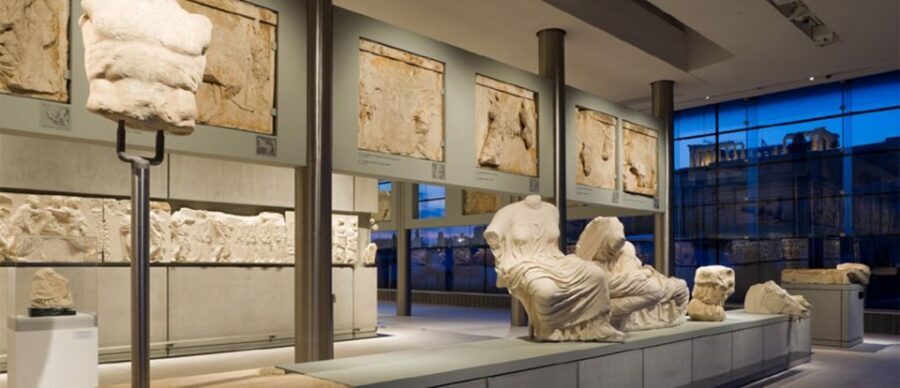
Two of the biggest highlight themes are the votive offerings to Athena and the Caryatids. The tour doesn’t just point to these pieces as famous names; it explains why they’re tied to belief, ceremony, and identity in ancient Athens.
Athena offerings are especially important because they connect art to religion. You learn how these dedications functioned in the city’s spiritual life, not just how they look. And with the Caryatids, the guide helps you see them as architectural and symbolic figures, not as isolated statues.
If you want your museum visit to feel like it has a spine, these stops do the job.
The glass atrium aligned with the Parthenon: a smart visual connection
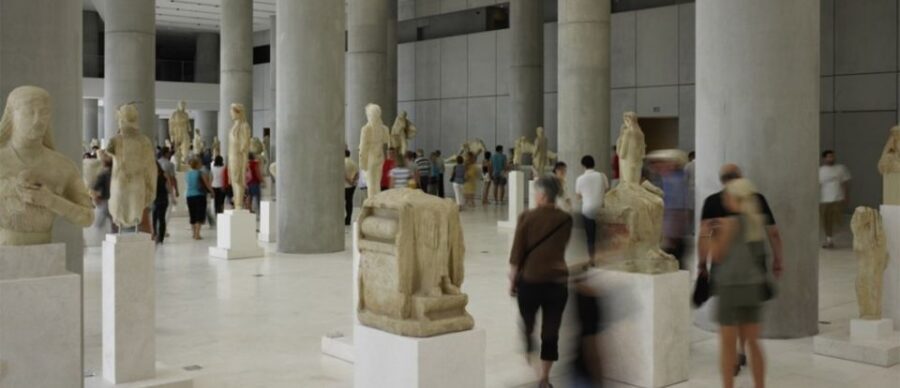
One of the tour’s most distinctive features is the museum’s glass atrium designed in alignment with the Parthenon. It’s one of those architectural choices that you understand immediately once you’re standing where the museum wants you to stand.
The guide typically uses this moment to connect the indoor artifacts to the outdoor structure. In other words, you’re not just learning about the Parthenon; you’re learning how the museum’s layout helps you compare the concept of the building with what’s preserved inside.
Excavations through glass floors: seeing the ground truth
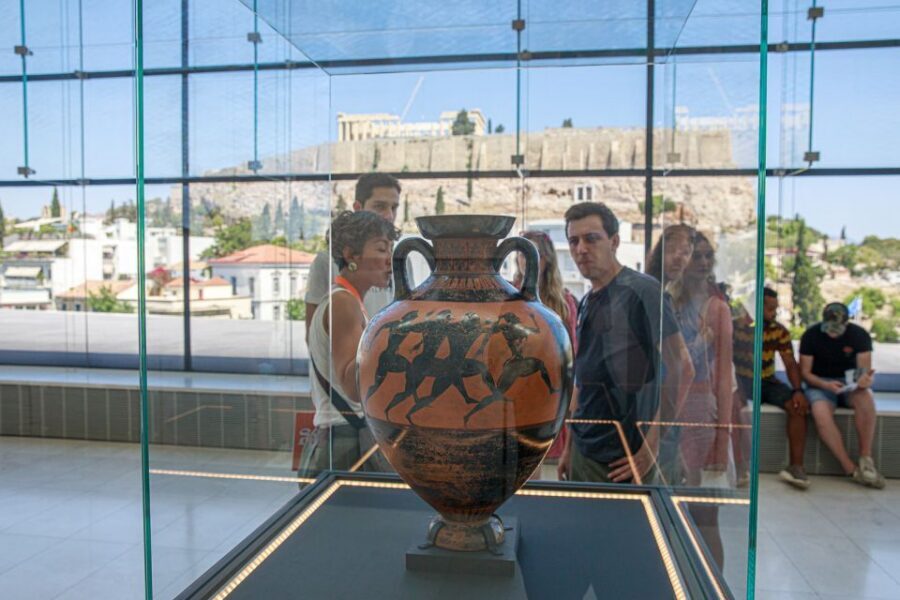
This is one of the most practical “wow” elements in the museum. The tour points out excavations made visible through stunning glass floors. That means you get a reminder that the Acropolis area wasn’t a clean stage set—it was a place with layers of life.
The guide helps you connect those visible remnants to the idea of what stood there, and the glass presentation makes it hard to ignore the fact that you’re walking over real archaeological evidence. If you like evidence you can see, this part lands well.
3D exhibits and a look at an ancient Athenian neighborhood
The museum also offers reconstructed context through 3D exhibits and a plexiglass-floor reveal of an ancient Athenian neighborhood. The purpose here is simple: it helps you understand the museum in relation to daily city life around the Acropolis, not just the monument itself.
This section can be a big help if you’re the type who wants to visualize how things fit together. You’re given a mental map of what this area might have looked like, so the objects in the galleries stop feeling like random finds and start feeling like pieces of a bigger urban story.
Panoramic views of the Acropolis ruins, from inside
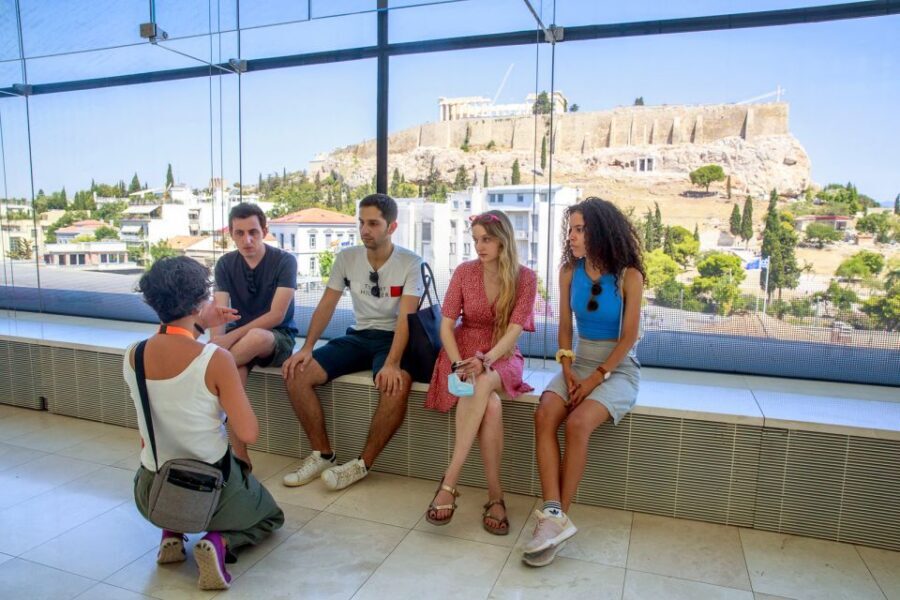
Another highlight is the chance to enjoy panoramic views of the ruins of the Acropolis from within the museum experience. That matters because it bridges the museum to the main event outside. Instead of treating them as two separate visits, you’re encouraged to link them in your mind.
These views are also practical. If weather is hot or changeable, the museum gives you a way to keep your momentum while still seeing the monument. And since tours run in all weather conditions, having a sheltered way to keep the experience going is a real advantage.
Price and value: what $41 plus entrance fees really means
The price is listed at $41 per person for the guided experience, and the entrance fees are not included—about €20 per adult. That can look like a lot at first glance, but it usually makes sense once you factor in what you’re buying.
You’re paying for:
- a local licensed guide
- a skip-the-ticket line service
- a guided route designed for a short visit (75 minutes)
If you’d otherwise arrive at the museum and spend your time figuring out what’s most important, the guide is the difference between seeing items and understanding them. If you already know exactly which galleries you want and you’re comfortable moving fast through a museum, you might feel the price less strongly.
My take: if this is your only museum stop in Athens (or your Acropolis visit depends on context), the value is solid. If you’re planning a long museum day with extra time, you could consider doing it more independently and use a museum map.
What can slow you down: short duration and starting points
Two timing considerations show up in the experience details.
First, 75 minutes goes quickly. One common theme with short museum tours is that they can feel a bit brief, especially if you want to linger. Go in knowing you’ll be prioritizing the most important highlights.
Second, your museum segment may not start immediately at the scheduled time if it’s run as part two of a longer program that includes an Acropolis visit first. When that happens, delays can squeeze the museum window. If you have a tight day plan, build in buffer so you’re not racing from the museum to another commitment.
Practical tips that make your guided visit smoother
- Wear comfortable shoes. You’ll be on your feet, and museum walking adds up fast.
- Bring passport or ID. It’s listed as required.
- Don’t bring luggage or large bags. This is explicitly not allowed.
- Dress for rain or shine. Tours run in all weather conditions.
- Plan for entrance fees at the museum since they’re not included in the tour price.
Also, if you care about maximizing time, arrive early enough to settle in and get oriented before you meet the guide. This is the kind of tour where arriving a few minutes late can change what you see.
Who should book this Acropolis Museum guided tour?
This experience is a strong fit if you:
- want the fastest path to understanding the Acropolis before you climb on the hill
- prefer a guided route in a major museum rather than wandering
- appreciate architecture connections (the museum’s alignment with the Parthenon is a real hook)
- like explanations that keep things clear and organized for a short visit
It’s less ideal if you want a slow, “read every label” museum day. The time is fixed, and the tour focuses on the key highlights rather than letting you roam.
It’s also a good choice for families when a guide knows how to involve younger visitors. In past departures, a guide named Annie is described as getting a 7-year-old actively involved, which shows the tour can work beyond a strictly adult pace.
Should you book this Acropolis Museum guided tour?
Book it if your Acropolis visit will feel more meaningful with context and if you want a guide to point out what matters. The combination of Athena-focused artifacts, Caryatids, glass-floor excavations, 3D neighborhood context, and the Parthenon-aligned architecture makes this museum tour more than a quick look—it’s a way to connect the inside collection to the outside monument.
Skip it if you already plan to spend hours in the museum and you prefer self-guided discovery. Also skip or reconsider if your schedule is too tight to absorb potential start delays from a linked Acropolis-first program.
In the end, I see this tour as good value for people who want their Athens to feel understandable, not overwhelming—and who want that “now I get it” moment when the Acropolis stops being just a view.
FAQ
How long is the Athens Acropolis Museum guided tour?
The duration is 75 minutes.
What is included in the price?
You get a local licensed guide and a skip-the-ticket line service.
Are entrance fees included?
No. Entrance fees are not included and are approximately €20 per adult.
Where do I meet the tour staff?
Meet at 3, Dionysiou Areopagitou St., at Lukumades & Pilino stores. Staff holding an orange Athens Walking Tours sign will be there.
Is the tour guide available in English?
Yes, the live tour guide is English.
Is the tour wheelchair accessible?
Yes, it is wheelchair accessible.
Is luggage allowed?
No. Luggage or large bags are not allowed.
What should I bring?
Bring a passport or ID card and wear comfortable shoes.
Does the tour run in bad weather?
Yes. Tours take place in all weather conditions, rain or shine.
What are the cancellation and payment options?
Free cancellation is available up to 24 hours in advance for a full refund. You can also reserve now and pay later (pay nothing today).