REVIEW · ATHENS
Athens: The Acropolis Guided Walking Tour in German
Book on GetYourGuide →Operated by LITTLE OWL TOURS · Bookable on GetYourGuide
The Acropolis makes more sense with a guide. I like the German commentary for keeping every stop clear, and I also love the smooth skip-the-line entry that saves time and energy. The trade-off: this is a walk uphill on uneven, sometimes slippery ground, and there’s no elevator, so it’s not a good fit if mobility is limited.
This is a 1.5-hour, licensed-guided route that starts on the side of the hill and works upward toward the main monuments. Guides can bring the story to life in a relaxed, humor-friendly way, and one example you may hear in German groups is Jessica, who’s known for explaining with time for questions and helpful visuals. After the tour, you get time to wander the site on your own, with tickets that let you return to the best spots for photos.
In This Review
- Key moments that make this tour click
- Paying $95: what you’re buying besides entry tickets
- Where the tour starts and how the route actually feels
- Stop 1: Theatre of Dionysos, where the story begins
- Stop 2: Asklepion ruins and the early hospital idea
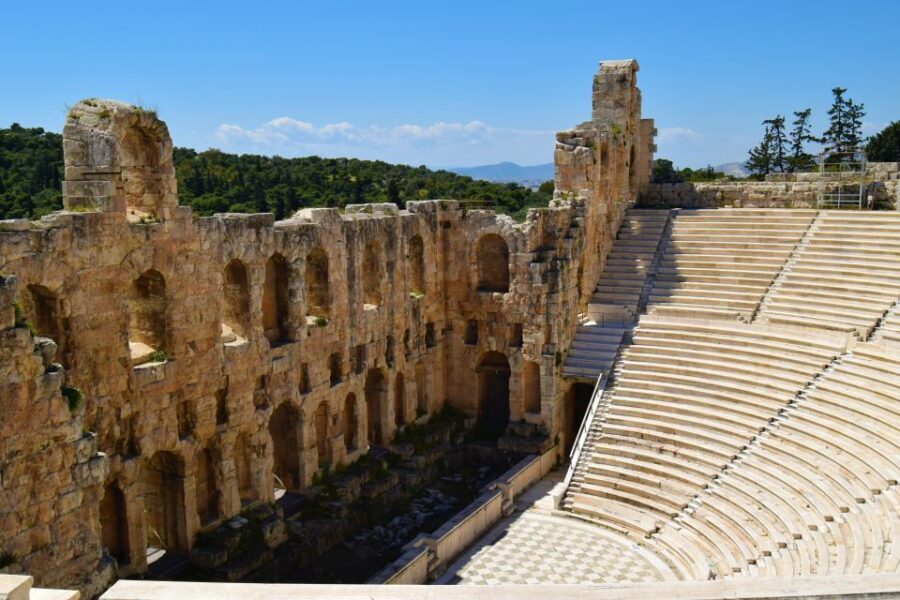
- Stop 3: Odeon of Herodes Atticus—public culture at full volume
- Stop 4: Propylaea, the monumental entrance moment
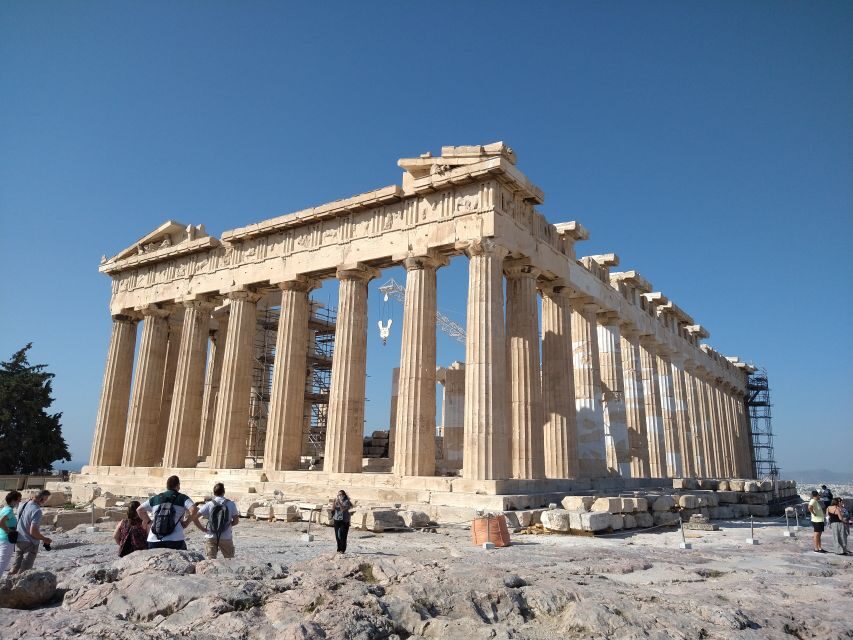
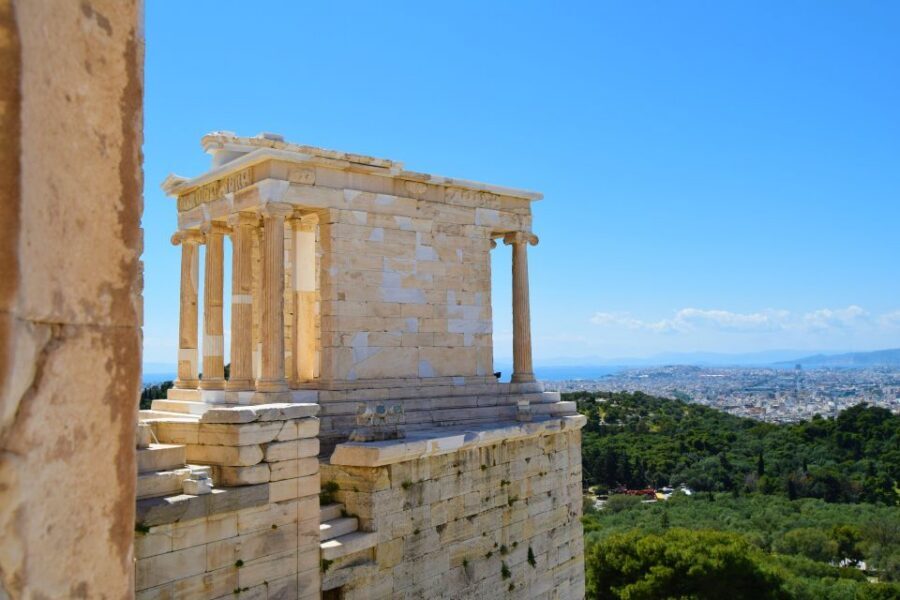
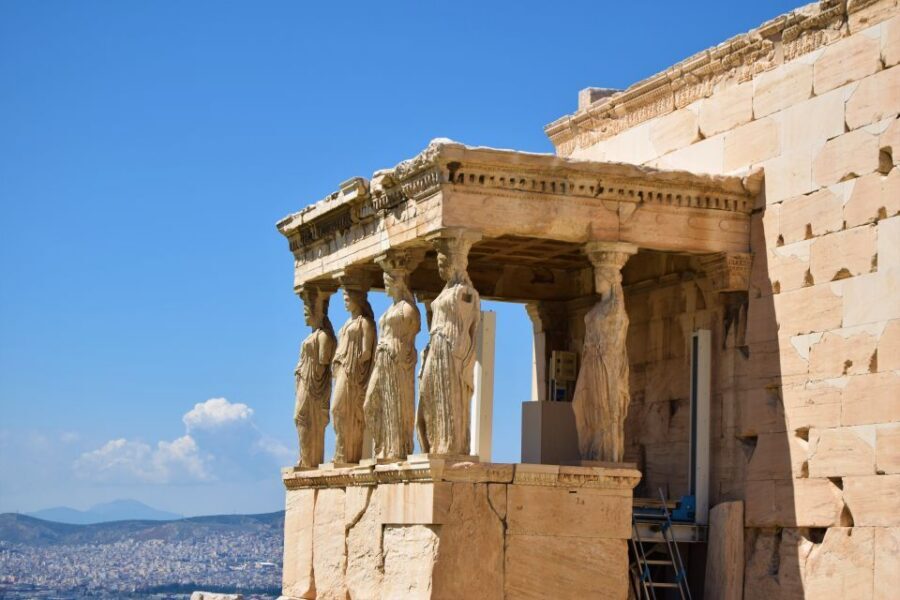
- Stop 5: The temples—Parthenon, Erechtheion, and the Temple of Athena Nike
- Photo stop and free time: use the site like a local
- The 360° view at the end: why the timing matters
- What’s included, what’s not, and how to plan your day
- What to bring (and what will slow you down)
- Language: German guide, and why that can change everything
- Who should book this Acropolis walking tour
- Should you book? My decision guide
- FAQ
- FAQ
- How long is the Acropolis guided walking tour in German?
- Does the tour include an entry ticket to the Acropolis?
- What language is the live guide?
- Where does the tour meet?
- Is food or drinks included?
- What should I bring for the tour?
- Is the tour suitable for people with limited mobility?
Key moments that make this tour click
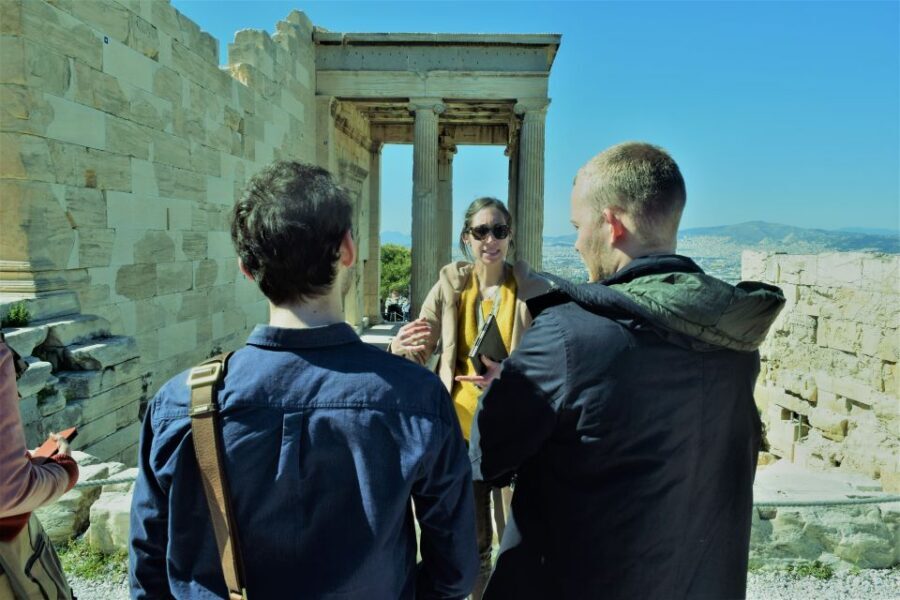
- Theatre of Dionysos first: you sit in the kind of seats ancient audiences used and get the origin story of Greek theatre.
- Asklepieion ruins: you pass what’s often described as one of the earliest hospital sites in ancient Greece.
- Odeon of Herodes Atticus: you connect the dots between Greek spaces and later Roman-era performances.
- Propylaea to the temples: you see the Parthenon, Erechtheion, and Temple of Athena Nike as a coordinated complex, not random ruins.
- A real 360° finish: the top-of-hill viewpoint helps you understand why the Acropolis was built here in the first place.
Paying $95: what you’re buying besides entry tickets
At $95 per person for a 1.5-hour group tour, you’re not just paying for access to the Acropolis. You’re paying for three things that matter on a crowded, stone-heavy site: a licensed guide, a pre-booked entry setup that helps you avoid long lines, and guided time that turns “I’ve seen photos” into “I get what I’m looking at.”
If you’ve ever tried to figure out the Acropolis on your own, you know the problem: you’re surrounded by major structures, but without context they can blur together. This tour is built to keep the sequence logical—start at the theatre, work your way up past civic and sacred sites, then arrive at the temple cluster with the right mental picture. That pace is the real value.
Also, you’re not forced to rush. The tour ends with time to explore after you finish the guided portion. So even if you prefer lingering at the Parthenon area for photos, you’re not trapped in a tight “see it and leave” format.
Other Acropolis and Parthenon tours we've reviewed in Athens
Where the tour starts and how the route actually feels
The meeting point can vary based on the option you book, but the walking route begins on the side entrance of the hill. From there, you head first to the theatre of Dionysos, which is a smart opener because it gives you a foundation: this hill wasn’t only about temples. It was also about public life, performances, and community rituals.
The walking itself is uphill and on uneven surfaces. There’s no elevator and no step-free route listed. Even if you’re in decent shape, plan for a steady climb and for moments where you’ll need to watch your footing—especially if conditions are slick. Comfortable shoes aren’t optional here; they’re the difference between enjoying the views and doing a constant micro-worry about each step.
One small detail that improves the whole experience is group size. Some German groups have been small enough to stay close together (for example, one group was around 9 people), which makes questions easier and helps you keep your place on the route.
Stop 1: Theatre of Dionysos, where the story begins
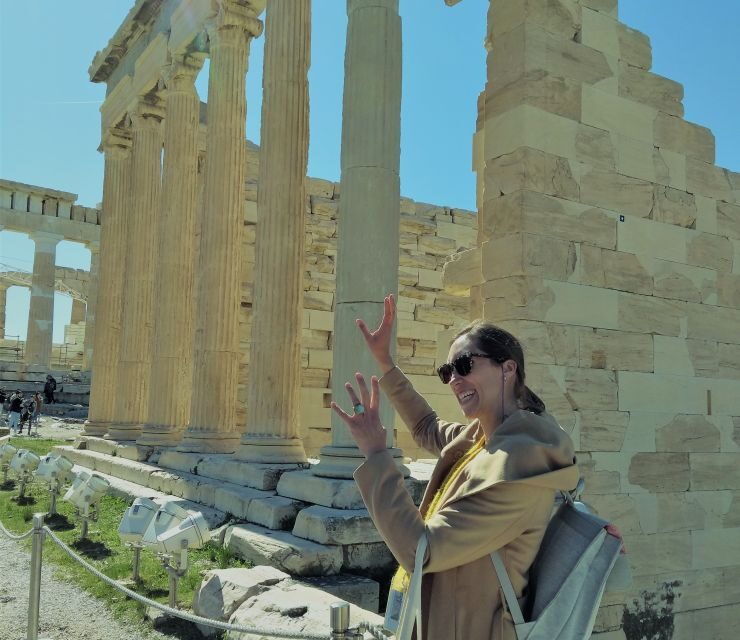
The tour starts at the theatre of Dionysos. You’ll be guided to grab a seat on the ancient seating area, not just stand in front of it. That single change—actually experiencing the seating—helps you understand what this place meant. Theatre here wasn’t a separate entertainment venue. It was tied to the culture and festivals that shaped Athens.
This stop is valuable because it gives you a framework before you ever reach the famous temple buildings. Once you hear how the theatre connects to the roots of Greek theatre, the whole Acropolis complex feels less like a museum exhibit and more like a living stage where ideas, stories, and civic identity all mixed.
Practical tip: when you’re sitting, take a moment to look outward, not only at the stone seats. Visualizing where performers would have faced makes later “myth and architecture” explanations much easier to follow.
Stop 2: Asklepion ruins and the early hospital idea
As the route climbs along the sunny/southern side of the Acropolis, you pass remains tied to the Asklepieion, described as one of the first hospitals in ancient Greece.
Even if you’re not a “medical history” person, this stop changes your view. You start noticing that the Acropolis wasn’t only a religious summit. It also served practical needs. Seeing a site associated with healing makes the hill feel more human-scale—less “untouchable marble” and more “a place where people came for help.”
It’s also a good break in the emotional rhythm of the tour. The theatre stop primes you for stories; the hospital site adds a different kind of story: civic care and beliefs about health.
Stop 3: Odeon of Herodes Atticus—public culture at full volume
Next comes the Odeon of Herodus Atticus. This is where the tour connects eras. You’ll hear about the theatre tradition in a broader sense and get a sense of how performance spaces evolved.
The reason this stop works on a guided tour is simple: it prevents the “look at another ruin” problem. With a guide, you understand why the Odeon belongs on this climb and how it relates to the Acropolis as a cultural stage—not just a temple display.
If you’re the kind of person who likes your history to have links, you’ll appreciate how this stop helps you build a mental map of Athens’ public life up on the hill.
Other Acropolis walking tours we've reviewed in Athens



Stop 4: Propylaea, the monumental entrance moment
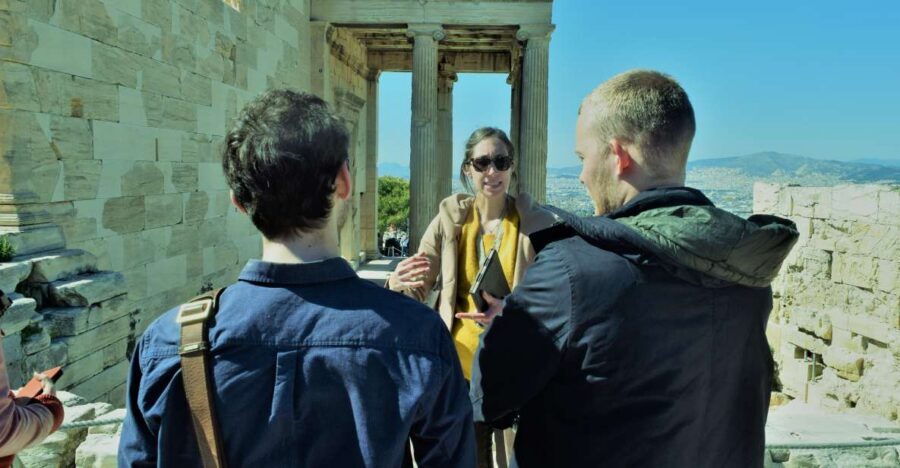
Now you’re approaching the heart of the complex. The Propylaea—the monumental entrance gate—acts like a threshold. The tour uses this moment to shift your focus from the outer cultural spaces to the central religious and architectural zone.
This is one of those stops that feels better with guidance because you’re not only passing through. You’re learning how to read the design: where your eye should go first, what the gate “frames,” and how it sets up the big temple reveal.
When you cross into the higher area, the tour helps you see the Acropolis as an organized plan. Without that, it’s easy to treat each structure as separate.
Stop 5: The temples—Parthenon, Erechtheion, and the Temple of Athena Nike
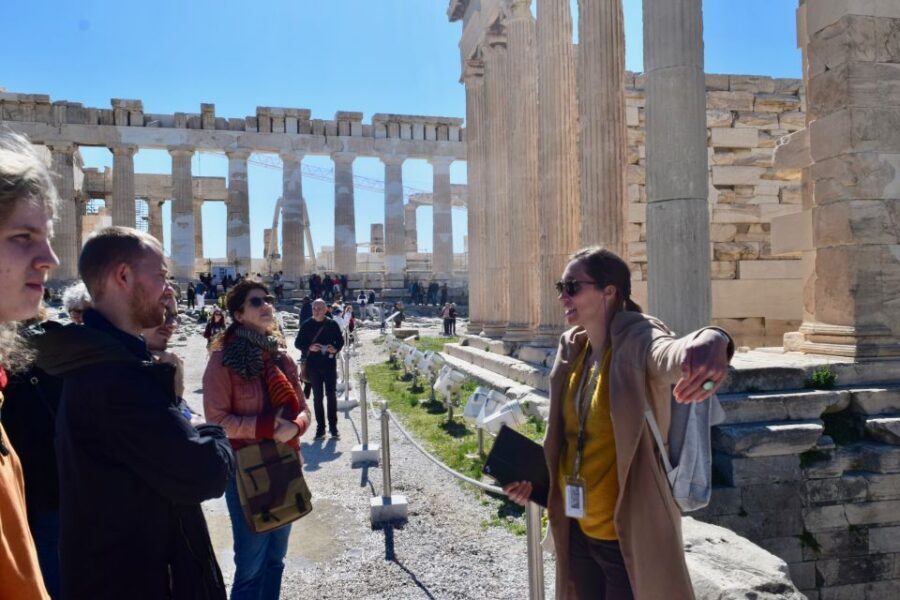
At the top, you get views of the three major temple elements named in the tour: the Parthenon, the Erechtheion (Erechtheion), and the Temple of Athena Nike.
What I like about this structure is that the guide doesn’t just point and name. You’re guided to take in how the buildings sit together, and you hear about the architect’s techniques and myths tied to the monuments. Even when the details are delivered as story, the underlying effect is practical: it helps you understand why these structures are famous and how they were engineered to look “right” from the kinds of angles people actually stood at.
The Parthenon area is the emotional peak for most visitors. If you’re someone who wants to absorb the architecture with less rushing, treat this segment as your slow zone. Look around first, then let the guide’s notes anchor what you’re seeing.
Photo stop and free time: use the site like a local
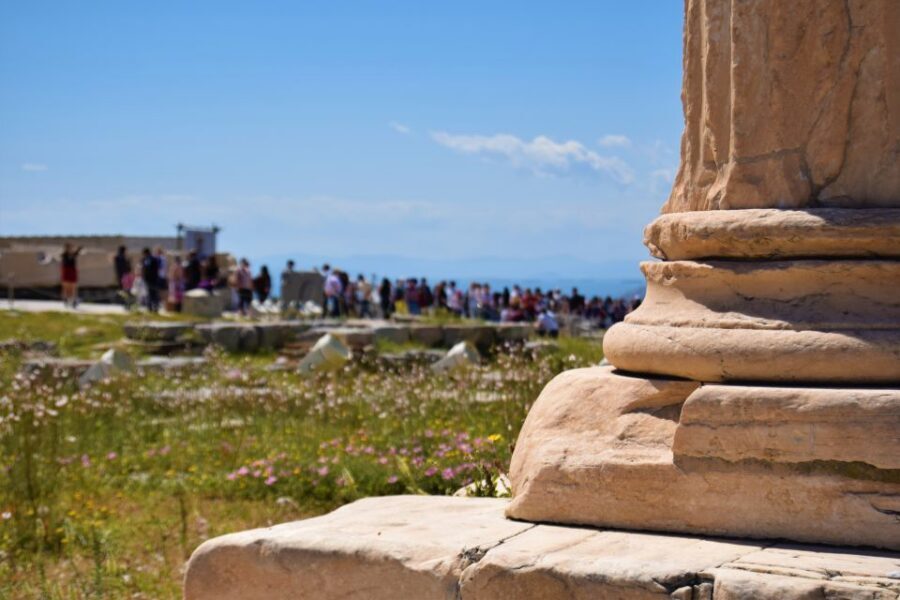
The tour wraps with time to explore, and there’s also a Parthenon photo stop and additional free time afterward. One smart advantage here is that you can return to revisit your favorite spots at a calmer pace. Tickets are described as valid for the whole day in at least one guide experience, which is useful if you want to wait for nicer lighting or just take a second pass once you know what matters.
How to use the free time well:
- Start with the view you enjoyed most during the guided segment, then walk a little farther to catch different sightlines.
- If you’re photographing, don’t stay planted. Move slightly and watch how the angle changes the “feel” of the Parthenon and surrounding structures.
- If you still have questions from the guide, this is your moment to circle back and compare what you heard with what you see.
This is one of the best ways to turn a short tour into a longer, more rewarding visit.
The 360° view at the end: why the timing matters
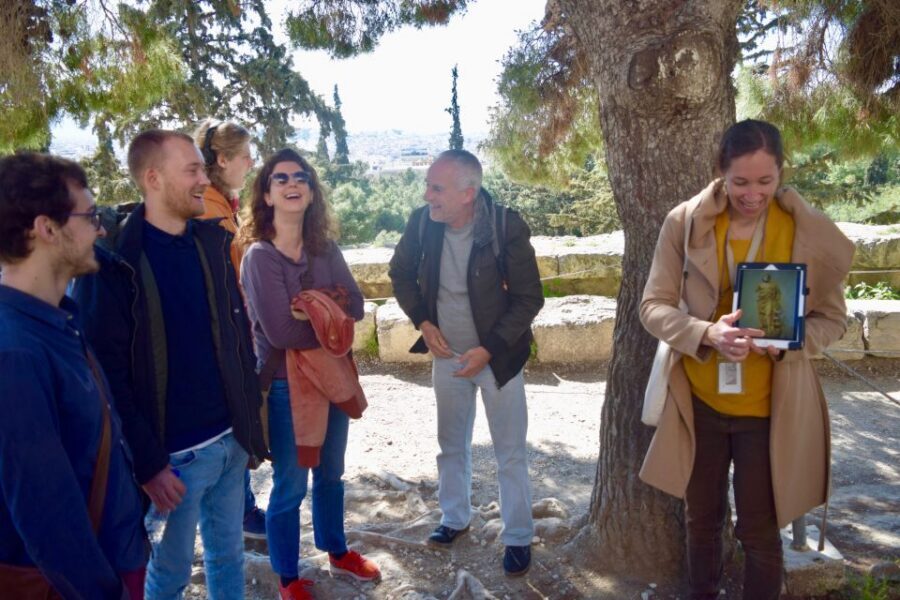
The tour finishes on the top of the hill with a 360° view of Athens. I like finishing here because it turns your “close-up reading” into “big-picture understanding.”
From the summit viewpoint, you can get oriented quickly: you see how the city spreads out and you get a feeling for why this spot was chosen. The monuments stop feeling like isolated masterpieces and start feeling like the center of a landscape of streets, neighborhoods, and routes.
Timing also helps. Even though you’re only on the hill for about 1.5 hours during the guided portion, the end gives you a final mental reset. You leave with both details and direction.
What’s included, what’s not, and how to plan your day
Included:
- Acropolis entry ticket
- Guided walking group tour with a licensed guide
- Free time to explore after the tour
- Administration fees for ticket pre-booking
Not included:
- Food and drinks
- Hotel pickup/drop-off
That means you should plan to bring water and treat the tour as an activity block that sits in the middle of your day. You’ll be on a site where breaks aren’t always easy to find at the exact moment you want one, so carrying what you need saves you from the usual “I didn’t bring enough” stress.
Since no food is included, think of this as a “morning or early afternoon” kind of plan, depending on heat. You’ll be walking and standing in sun.
What to bring (and what will slow you down)
Bring:
- Comfortable shoes
- Sunglasses
- Sun hat
- Water
- Passport or ID card (copy accepted)
Not allowed:
- Baby strollers
- Food and drinks
- Luggage or large bags
- Pets (assistance dogs allowed)
A couple of these points matter more than they sound. Shoes protect you from the uneven terrain. Water matters because you’re moving uphill. And no luggage/large bags means you’ll want to travel light—use hotel storage and keep your essentials in a small day bag.
Language: German guide, and why that can change everything
This is a live German tour guide experience. If German is your strongest language, this can be a big quality-of-visit difference. It’s not just about understanding facts. It’s about understanding the tone—humor, myth, and the little architectural explanations become easier when you’re not decoding on the fly.
For German speakers, this kind of language match is often the difference between passively listening and actively connecting the story beats.
Who should book this Acropolis walking tour
Book this if:
- You want a guided, structured walk instead of wandering temple-to-temple with guessing.
- You like explanations that mix architecture with story.
- You prefer a shorter, focused route with time to explore on your own afterward.
- You’re comfortable with uphill walking on uneven ground.
Skip it (or consider another option) if:
- You have mobility impairments or limited ability to walk uphill.
- You rely on step-free access, since there’s no elevator mentioned.
- You’re traveling with items that fall under the “not allowed” list (like large bags or strollers).
Should you book? My decision guide
If you’re trying to do the Acropolis in a way that feels understandable and efficient, this tour is a strong choice. The price makes sense when you factor in the guided time, the licensed instruction, and the practical convenience of skip-the-line entry plus a site visit window with free exploration time afterward.
The main reason to hesitate is purely physical: you’ll be walking uphill on uneven stone with no elevator. If you’re good on your feet and want your Acropolis visit to connect the dots, this German guided walking tour is one of the clearer, better-organized ways to do it.
FAQ
FAQ
How long is the Acropolis guided walking tour in German?
The tour duration is 1.5 hours.
Does the tour include an entry ticket to the Acropolis?
Yes. Entry ticket to the Acropolis is included, along with skip-the-ticket-line access.
What language is the live guide?
The tour is guided in German.
Where does the tour meet?
The meeting point may vary depending on the option you book.
Is food or drinks included?
No. Food and drinks are not included.
What should I bring for the tour?
Bring comfortable shoes, sunglasses, a sun hat, water, and a passport or ID card (a copy is accepted).
Is the tour suitable for people with limited mobility?
It is not recommended for people with limited mobility, and there is no elevator. The tour involves walking uphill on uneven surfaces.